Rarely, I encounter an article in the financial press which is worth reading several times. The following piece by David Rosenberg is one of them. It is concise, logical, and presents a range of actionable items that investors may wish to consider, especially given the present state of equity markets here and in the U.S.
David Rosenberg: Here are 10 tips for investing late (very late) in the business cycle
Rosenberg reviews 15 economic indicators and concludes that we are in the late stages of the most recent expansion. It's time to undertake a thorough review of one's portfolio in light of this.
He concludes his article with some sage advice.
So how to invest?
Answer: Be aware of where we are in the cycle and act appropriately by having an optimal portfolio for this part of the business cycle:
1. Raise some cash — sometimes a 1 per cent yield on a three-month T-bill will have to suffice.
2. Reduce domestic cyclical exposure.
3. Focus on companies with strong balance sheets; low refinancing risks.
4. Cut the overall beta of the equity portfolio.
5. Screen more heavily on earnings quality and predictability.
6. Protect the equity portfolio by writing call options or buying puts.
7. Diversify geographically into markets that are in an earlier part of the cycle (many parts of Europe, Asia).
8. Step up investments in dividend growth/yield and in less economically sensitive parts of the market.
9. Credit hedge funds with attention paid to better quality should help preserve capital and provide a recurring cash flow.
10. Long-term bond yields (even zero coupon) never rise during a recession so no matter how low they are, then can indeed go even lower unless this game goes to extra innings.
I have adopted most of them, including reducing my exposure to what I consider are more vulnerable equity positions ... but not without some misgiving as I have negated the "opportunity" for potentially rewarding gains. At the same time, I have foregone the "opportunity" to experience losses and in so doing, have conserved my stash for more promising times.
As to timing: In my view, investing for most retail investors is a "long game" played in terms of decades with innings in the order of 3 to 5 years. Over the years, I've learned that "buy and hold" (with a few exceptions) is not the best strategy for me. As in sailing, you simple cannot reach a destination by holding one's course to a single tack. You alter your course in response to wind, waves and currents.
The secret is to prepare as much as you can in advance by consulting charts and weather forecasts and, always ... to have plans for coping on the basis of that information and, always ... to leave an excess of room for leeway. So, too, it is with investing.
I recommend highly, the articles written by David Rosenberg. His "batting average" (for great articles) is higher than most of his peers.
Sunday, 11 February 2018

Saturday, 27 January 2018
Market Crash - Thoughts about Risk Management - Note 4
Howard Marks of Oaktree Capital Management, L.P. has released his newest newsletter. It reflects his latest thinking on the investment climate and is well worth reading as he provides balanced assessment of positive and negative perspectives - also the short and long-term implications of change in U.S. tax policy. "Proceed with caution" is his advice.
Howard Marks' January News Letter
What to Do?
I have had (and still do have) a propensity for engaging in potentially risky activities: climbing, caving, long-distance cycle riding, wilderness canoeing, skiing etc. Like many of my companions, I engage in risk management. Here are a few of those practices which are relevant to the world of investing.
With the exception of the first two, they are presented in no particular order:
It's All About People
Only engage with people you can trust. The key strategy is to avoid people who are either inexperienced, take undue risks, ignore the well-being of others in the group, or who are accident prone. An unfortunate confluence of these factors led to a death of a friend on one trip many years ago.
re investing:
Invest only in companies with ethical management working in the interests of their shareholders ... and managers with successful track records. Considering the risks these days, I look especially for long tenured management which has steered companies successfully through at least one full market cycle.
Strategic Thinking - Risk Minimization
A great many accidents happen because people find themselves in the wrong place, with the wrong "stuff" (equipment, skills, mental attitude etc.) when bad things happen. Prior to a prospective adventure, one must match one's capacity (group included) with the nature of potential situations that could arise. It's all about the minimization of risk. There are a few possible outcomes:
It's all about risk reward. In this respect, it literally pays to take the long view: to consider that it might be prudent to protect one's gains and invest one's stash in vehicles that are potentially more resilient during market declines.
Preparation and Training
Risk assessments are used to identify preparations that must be done prior to an adventure: skills and equipment required, nature of the training for members of the crew, timing, and final review. Deficiencies of any element are rarely acceptable depending on the severity of potential consequences.
re investing:
There are several potential tactical measures to reduce investment risk. Some of them include options and interest-generating vehicles. Familiarization and practice with these instruments may be considered by people interested in protecting their stash. A useful book, Options Trading for the Conservative Investor by Michael C. Thomsett (Pearson Education Ltd. 2010) is worth reading. This is only one of many excellent books on the topic. If you are new to options trading, it makes sense to practice on virtual trading platforms in order to get a better sense of the process without having to risk real money.
Situational Awareness - Vigilance
There are times when one can relax and others where it is important to pay close attention. This "spidey sense is a combination of training, experience and attitude. I never travel with people lacking this capacity.
re investing:
While some may equate nervousness with the strategy of trying to time the market, I take a view which derives from an investing time horizon that generally is in the frame of five to ten years. My sense of the current situation is that risk is increasing. I have decided to adjust and apportion my portfolio on the basis of perceived risk: to place parts in "slower moving" lower areas of risk and a smaller portion in more "responsive" higher "risk" investment vehicles. That way, I can have exposure to future gains with the hope that the bulk of the portfolio will be somewhat more resilient. I will focus more on the more dynamic elements as opposed to spreading my efforts more widely. It's all a matter of focus.
Contingency Planning
Good and bad things happen - both anticipated and not. Agility and preparedness are required to address these eventualities. Many adventurers game out "what if" scenarios. The very act of doing so, I would argue, prepares people to cope more readily with totally unanticipated situations as it promotes a more flexible mindset.
re investing
This is one time where it pays to read widely and to hop out of one's "reading rut" - to get exposure to ideas that one might discount out of hand. This has two effects: challenges current thinking; offers new possibilities to be considered. My reading has expanded to include: selected local, regional and national newspapers and government agencies; ditto for trade/professional magazines and journals. With a few exceptions, however, I ignore the financial press. I do read quarterly and annual newsletters from a few money managers. The reading provides better situational awareness and, sometimes, reveals potential strategies to address emerging trends (either fast or slow moving).


Howard Marks' January News Letter
What to Do?
I have had (and still do have) a propensity for engaging in potentially risky activities: climbing, caving, long-distance cycle riding, wilderness canoeing, skiing etc. Like many of my companions, I engage in risk management. Here are a few of those practices which are relevant to the world of investing.
With the exception of the first two, they are presented in no particular order:
It's All About People
Only engage with people you can trust. The key strategy is to avoid people who are either inexperienced, take undue risks, ignore the well-being of others in the group, or who are accident prone. An unfortunate confluence of these factors led to a death of a friend on one trip many years ago.
re investing:
Invest only in companies with ethical management working in the interests of their shareholders ... and managers with successful track records. Considering the risks these days, I look especially for long tenured management which has steered companies successfully through at least one full market cycle.
Strategic Thinking - Risk Minimization
A great many accidents happen because people find themselves in the wrong place, with the wrong "stuff" (equipment, skills, mental attitude etc.) when bad things happen. Prior to a prospective adventure, one must match one's capacity (group included) with the nature of potential situations that could arise. It's all about the minimization of risk. There are a few possible outcomes:
- abandon the project and do nothing
- modify the project (timing, duration, intensity, etc.)
- select a "safer" project
The key is to know one's self, be aware of potential risks, and avoid situations where they exceed one's "limits of safety".
re investing:
Herr Buffet states the the first, second and third rules of investing are "not to lose money".
It is inevitable that a recession will take place. When/where/how - it's uncertain. The last five years have been exceptional. It's well worth considering the possibility of heading to a safe haven to enjoy gains, especially with the knowledge that the sun will shine after the storm's passage.
In a previous post, I presented a graph illustrating the impact of portfolio losses. Here it is again:
It is inevitable that a recession will take place. When/where/how - it's uncertain. The last five years have been exceptional. It's well worth considering the possibility of heading to a safe haven to enjoy gains, especially with the knowledge that the sun will shine after the storm's passage.
In a previous post, I presented a graph illustrating the impact of portfolio losses. Here it is again:
It's all about risk reward. In this respect, it literally pays to take the long view: to consider that it might be prudent to protect one's gains and invest one's stash in vehicles that are potentially more resilient during market declines.
Preparation and Training
Risk assessments are used to identify preparations that must be done prior to an adventure: skills and equipment required, nature of the training for members of the crew, timing, and final review. Deficiencies of any element are rarely acceptable depending on the severity of potential consequences.
re investing:
There are several potential tactical measures to reduce investment risk. Some of them include options and interest-generating vehicles. Familiarization and practice with these instruments may be considered by people interested in protecting their stash. A useful book, Options Trading for the Conservative Investor by Michael C. Thomsett (Pearson Education Ltd. 2010) is worth reading. This is only one of many excellent books on the topic. If you are new to options trading, it makes sense to practice on virtual trading platforms in order to get a better sense of the process without having to risk real money.
Situational Awareness - Vigilance
There are times when one can relax and others where it is important to pay close attention. This "spidey sense is a combination of training, experience and attitude. I never travel with people lacking this capacity.
re investing:
While some may equate nervousness with the strategy of trying to time the market, I take a view which derives from an investing time horizon that generally is in the frame of five to ten years. My sense of the current situation is that risk is increasing. I have decided to adjust and apportion my portfolio on the basis of perceived risk: to place parts in "slower moving" lower areas of risk and a smaller portion in more "responsive" higher "risk" investment vehicles. That way, I can have exposure to future gains with the hope that the bulk of the portfolio will be somewhat more resilient. I will focus more on the more dynamic elements as opposed to spreading my efforts more widely. It's all a matter of focus.
Contingency Planning
Good and bad things happen - both anticipated and not. Agility and preparedness are required to address these eventualities. Many adventurers game out "what if" scenarios. The very act of doing so, I would argue, prepares people to cope more readily with totally unanticipated situations as it promotes a more flexible mindset.
re investing
This is one time where it pays to read widely and to hop out of one's "reading rut" - to get exposure to ideas that one might discount out of hand. This has two effects: challenges current thinking; offers new possibilities to be considered. My reading has expanded to include: selected local, regional and national newspapers and government agencies; ditto for trade/professional magazines and journals. With a few exceptions, however, I ignore the financial press. I do read quarterly and annual newsletters from a few money managers. The reading provides better situational awareness and, sometimes, reveals potential strategies to address emerging trends (either fast or slow moving).


Big Salmon River - Yukon Territory
Tuesday, 23 January 2018
Market Crash - Storm Watch Note 3
I am reading The End of Theory: Financial Crises, the Failure of Economics, and the Sweep of Human Interaction by Richard Bookstaber. The product of a brilliant mind coupled with diverse experience, it merits a deep read.
In brief, the Bookstaber posits that traditional economic models lack the capacity to deal with economic crises - the ultimate in model stress tests as it were [my view]. His analysis of the deficiencies of economic modelling in Section II, is penetrating and is, in itself, an intellectual journey of note. The book is worth reading for that alone.
Bookstaber's use of agent-based models opened new doors of understanding into the financial crises of 1987, 2008 and 2010. In essence, the disruptions are explained by"stories" describing the actions of various agents and how differences in their outlook and subsequent actions disrupted the "system" when one or more of the agents was put under stress.
If anything, I learned that it is impossible to predict the timing, extent and nature of the next disruption. As a friend of mine who has been in the stockbroking business (successfully) for 46 years recently said to me, "I've learned that you can only do the best you can and struggle through."
I am in the early stages of absorbing Bookstaber's work. With luck, I hope to identify a few indicators which might be used to monitor the stability of the "system" but I fear that it will be a fruitless exercise. Better to read voraciously and extensively in order to get an animalistic sense of the environment and then adapt as some conditions emerge.
For example, here is an insightful article by Ambrose Evans-Pritchard of The Telegraph:
World finance now more dangerous than in 2008, warns central bank guru
The world financial system is as dangerously stretched today as it was at the peak of the last bubble but this time the authorities are caught in a ‘policy trap’ with few defences left, a veteran central banker has warned.
Nine years of emergency money has had a string of perverse effects and lured emerging markets into debt dependency, without addressing the structural causes of the global disorder.
“All the market indicators right now look very similar to what we saw before the Lehman crisis, but the lesson has somehow been forgotten,” said William White, the Swiss-based head of the OECD’s review board and ex-chief economist for the Bank for International Settlements.
The refrain, "we've seen this before", is common to the observations of many people quoted by Pritchard-Evans. However, my sense is that the liquidity trap, the condition of most financial crises, will be sprung somewhat differently than in previous crises:
While banks now have high capital buffers, the risk has migrated elsewhere: to investment funds concentrated in crowded trades. The share of equities traded in “dark pools” outside the exchanges has mushroomed to 33pc. “A lack of market liquidity may lead to fire-sale risk, a downward price spiral,” it said.
One worry is what will happen to ‘risk parity’ funds when the inflation cycle turns. RBI Capital warned in its investor letter that these funds could lead to a “liquidity crash”. Deutsche Bank has advised clients to take out June 2018 ‘put’ options on the S&P 500 - a hedge against a market slide - arguing that the rally looks stretched and that risk parity funds will amplify any correction.
Some readers may dismiss Pritchard-Evans as a pessimist as he often expresses rather dark views of things such as the viability of the EU and the state of world affairs. However, it's always best to read widely and to explore new areas of investigation as a result.
For example, I followed up on some of the organizations represented by a few of the people quoted by Pritchard-Evans. It lead to yet more insights and the further shaping of a personal "view" of the state of the global financial system - also some potential strategies to address increased levels of risk.
I hope not to be caught on the strand when the next tsunami rolls in. Better to retreat now and enjoy the breezes from a safer location.
There are innumerable threats to the stability of the system. Taking a lead from the aforementioned article, I started to explore findings of the Office of Financial Research. One report in particular, Office of Financial Research Reports on Risks to Financial Stability (December 2017) lists some of the threats:
1. Vulnerabilities to cybersecurity incidents – A large-scale cyberattack or other cybersecurity incident could disrupt the operations of one or more financial companies and markets and spread through financial networks and operational connections to the entire system, threatening financial stability and the broader economy.
2. Obstacles to resolving failing systemically important financial institutions – There are two paths for the resolution of a failing systemically important financial institution that is not an insured depository institution. Both paths have shortcomings for handling the failure of the largest and most complex bank holding companies, known as global systemically important banks.
3. Structural changes in markets and industry – Three aspects pose threats: (1) lack of substitutability, or the inability to replace essential services if a provider fails or drops that line of business, (2) fragmentation of trading activities through multiple channels and products, and (3) the chance that the transition to a new reference rate to replace the London Interbank Offered Rate, or LIBOR, could be difficult.
I have subscribed to receive updates on the activities of the Office of Financial Research. If anything, I hope to gain a better appreciation of thinking processes and outlooks of various participants in the system. And occasionally, a few tidbits about potential strategies to cope with emergent opportunities and risk.
In brief, the Bookstaber posits that traditional economic models lack the capacity to deal with economic crises - the ultimate in model stress tests as it were [my view]. His analysis of the deficiencies of economic modelling in Section II, is penetrating and is, in itself, an intellectual journey of note. The book is worth reading for that alone.
Bookstaber's use of agent-based models opened new doors of understanding into the financial crises of 1987, 2008 and 2010. In essence, the disruptions are explained by"stories" describing the actions of various agents and how differences in their outlook and subsequent actions disrupted the "system" when one or more of the agents was put under stress.
If anything, I learned that it is impossible to predict the timing, extent and nature of the next disruption. As a friend of mine who has been in the stockbroking business (successfully) for 46 years recently said to me, "I've learned that you can only do the best you can and struggle through."
I am in the early stages of absorbing Bookstaber's work. With luck, I hope to identify a few indicators which might be used to monitor the stability of the "system" but I fear that it will be a fruitless exercise. Better to read voraciously and extensively in order to get an animalistic sense of the environment and then adapt as some conditions emerge.
For example, here is an insightful article by Ambrose Evans-Pritchard of The Telegraph:
World finance now more dangerous than in 2008, warns central bank guru
The world financial system is as dangerously stretched today as it was at the peak of the last bubble but this time the authorities are caught in a ‘policy trap’ with few defences left, a veteran central banker has warned.
Nine years of emergency money has had a string of perverse effects and lured emerging markets into debt dependency, without addressing the structural causes of the global disorder.
“All the market indicators right now look very similar to what we saw before the Lehman crisis, but the lesson has somehow been forgotten,” said William White, the Swiss-based head of the OECD’s review board and ex-chief economist for the Bank for International Settlements.
The refrain, "we've seen this before", is common to the observations of many people quoted by Pritchard-Evans. However, my sense is that the liquidity trap, the condition of most financial crises, will be sprung somewhat differently than in previous crises:
While banks now have high capital buffers, the risk has migrated elsewhere: to investment funds concentrated in crowded trades. The share of equities traded in “dark pools” outside the exchanges has mushroomed to 33pc. “A lack of market liquidity may lead to fire-sale risk, a downward price spiral,” it said.
One worry is what will happen to ‘risk parity’ funds when the inflation cycle turns. RBI Capital warned in its investor letter that these funds could lead to a “liquidity crash”. Deutsche Bank has advised clients to take out June 2018 ‘put’ options on the S&P 500 - a hedge against a market slide - arguing that the rally looks stretched and that risk parity funds will amplify any correction.
Some readers may dismiss Pritchard-Evans as a pessimist as he often expresses rather dark views of things such as the viability of the EU and the state of world affairs. However, it's always best to read widely and to explore new areas of investigation as a result.
For example, I followed up on some of the organizations represented by a few of the people quoted by Pritchard-Evans. It lead to yet more insights and the further shaping of a personal "view" of the state of the global financial system - also some potential strategies to address increased levels of risk.
I hope not to be caught on the strand when the next tsunami rolls in. Better to retreat now and enjoy the breezes from a safer location.
There are innumerable threats to the stability of the system. Taking a lead from the aforementioned article, I started to explore findings of the Office of Financial Research. One report in particular, Office of Financial Research Reports on Risks to Financial Stability (December 2017) lists some of the threats:
1. Vulnerabilities to cybersecurity incidents – A large-scale cyberattack or other cybersecurity incident could disrupt the operations of one or more financial companies and markets and spread through financial networks and operational connections to the entire system, threatening financial stability and the broader economy.
2. Obstacles to resolving failing systemically important financial institutions – There are two paths for the resolution of a failing systemically important financial institution that is not an insured depository institution. Both paths have shortcomings for handling the failure of the largest and most complex bank holding companies, known as global systemically important banks.
3. Structural changes in markets and industry – Three aspects pose threats: (1) lack of substitutability, or the inability to replace essential services if a provider fails or drops that line of business, (2) fragmentation of trading activities through multiple channels and products, and (3) the chance that the transition to a new reference rate to replace the London Interbank Offered Rate, or LIBOR, could be difficult.
I have subscribed to receive updates on the activities of the Office of Financial Research. If anything, I hope to gain a better appreciation of thinking processes and outlooks of various participants in the system. And occasionally, a few tidbits about potential strategies to cope with emergent opportunities and risk.
Saturday, 13 January 2018
Market Crash Storm Watch Note 2 - ratio of household net worth to disposable income
I have expanded my reading to include reports issued by various Federal Reserve Banks in the U.S.
I was impressed by the January 8, 2018 Economic Letter from the Federal Reserve Bank of San Francisco. In my view it is yet another indicator that a market correction is in the offing.
Valuation Ratios for Households and Businesses by Thomas Mertens, Patrick Shultz, and Michael Tubbs
For me, the highlight of the report is contained in the following paragraph and the accompanying graphic.
Ratio of household net worth to disposable income
The net worth-to-income (NW/Y) ratio—defined as household assets net of liabilities divided by personal disposable income—provides a valuation metric for a broad set of assets including debt, equity, and real estate weighted by the proportion in which they are being held by households. Similar to the P/E ratio, this ratio generally tends to revert toward its historical average and does not remain at extreme values, either high or low, for prolonged periods. As shown in Figure 3, the NW/Y ratio increased notably during both the dot-com boom and the housing boom and sharply contracted during the subsequent downturns.

Government boffins are always cautious about presenting their
findings. My antennae started to vibrate by the time I reached the conclusion of the Newsletter.
Current valuation ratios for households and businesses are high relative to historical benchmarks. Extending the analysis by Campbell and Shiller (1996), we find that the current price-to-earnings ratio predicts approximately zero growth in real equity prices over the next 10 years. Since the Great Recession, multiple asset classes—real estate, pensions, life insurance reserves, and equities—have been the main contributor pushing the household net worth-to-income ratio to a record high. Historically, these ratios have not remained elevated for prolonged periods, and peaks have been followed by reversions toward their long-run averages. At the same time, the present circumstances, including low current and expected interest rates, may warrant caution against bearish forecasts.
In my view, the net worth-to-income (NW/Y) ratio, when combined with the observations made in previous posts, is yet another indication of difficult times in the markets.
The storm clouds are on the horizon. Meanwhile, the party proceeds and people are reluctant to leave, fearing that they will miss out on the good times yet to come. There will be a reckoning.
I was impressed by the January 8, 2018 Economic Letter from the Federal Reserve Bank of San Francisco. In my view it is yet another indicator that a market correction is in the offing.
Valuation Ratios for Households and Businesses by Thomas Mertens, Patrick Shultz, and Michael Tubbs
For me, the highlight of the report is contained in the following paragraph and the accompanying graphic.
Ratio of household net worth to disposable income
The net worth-to-income (NW/Y) ratio—defined as household assets net of liabilities divided by personal disposable income—provides a valuation metric for a broad set of assets including debt, equity, and real estate weighted by the proportion in which they are being held by households. Similar to the P/E ratio, this ratio generally tends to revert toward its historical average and does not remain at extreme values, either high or low, for prolonged periods. As shown in Figure 3, the NW/Y ratio increased notably during both the dot-com boom and the housing boom and sharply contracted during the subsequent downturns.
Government boffins are always cautious about presenting their
findings. My antennae started to vibrate by the time I reached the conclusion of the Newsletter.
Current valuation ratios for households and businesses are high relative to historical benchmarks. Extending the analysis by Campbell and Shiller (1996), we find that the current price-to-earnings ratio predicts approximately zero growth in real equity prices over the next 10 years. Since the Great Recession, multiple asset classes—real estate, pensions, life insurance reserves, and equities—have been the main contributor pushing the household net worth-to-income ratio to a record high. Historically, these ratios have not remained elevated for prolonged periods, and peaks have been followed by reversions toward their long-run averages. At the same time, the present circumstances, including low current and expected interest rates, may warrant caution against bearish forecasts.
In my view, the net worth-to-income (NW/Y) ratio, when combined with the observations made in previous posts, is yet another indication of difficult times in the markets.
The storm clouds are on the horizon. Meanwhile, the party proceeds and people are reluctant to leave, fearing that they will miss out on the good times yet to come. There will be a reckoning.
Sunday, 7 January 2018
Market Crash Storm Watch Note 1 - Reducing Exposure and the Risk of Being Wrong re Timing
In my view, the market cycle is getting old. The potential for a correction within the next year or two is significant - to the point where some prudent measures should be taken soon in order to prepare for the downturn.
With this in mind, I have started by reducing my exposure to equities in a significant way.
A Few Givens
It is inevitable that a correction will take place. (See previous posts.)
It is impossible to know when a market correction will occur.
It is impossible to know the extent and type of a market correction.
In light of this, what to do?
I have experienced several corrections. There were a few consequences:

With this in mind, I have started by reducing my exposure to equities in a significant way.
I take the "long view". I have managed my affairs such that I have no debt and can live below my means if required. As a result, I can forgo the "opportunity" to make further gains if the market increases over the next year or two. In other words, I can afford to wait.
In essence, my strategy is to minimize losses and yet, have some exposure to the opportunity for further gains (with the thought that they might offset, to some extent, losses when they do occur).
It is inevitable that a correction will take place. (See previous posts.)
It is impossible to know when a market correction will occur.
It is impossible to know the extent and type of a market correction.
In light of this, what to do?
I have experienced several corrections. There were a few consequences:
- significant loss of money
- reduction in the level of confidence in my ability and my faith in equities markets
- fear of investing at the end of the recession - the time when opportunities were ripe
The last two consequences are psychological. Experience and reflection have taught me how to deal with them:
- to accept that losses are part of investing
- to realize that market cycles are normal
- to persevere through tough times
This time around, I will focus on the external - trying to minimize losses on equities due to downturns in the markets.
The Impact of Losses
The implications of the following chart are clear:
- the need to cut losses early
- the difficulty in making gains to offset losses increases significantly with the extent of losses (which explains why so many people have yet to recover from major crashes in equities markets and the collapse of the housing bubble)

Reducing Exposure to Equities Markets
I have reduced the number of positions in my portfolios. Characteristics of crew members who have been discharged include:
- high debt levels
- abnormally high P/E ratios
- sectors which are more prone to outsized losses during crashes
- complicated business models which are more prone to external shocks
In most instances, the reduction has been accomplished by eliminating entire holdings. In a few, I have retained a reduced position.
Crew members who are still on board have some of the following characteristics:
- robust financials
- leadership which has managed the company through at least one market cycle
- a market for products and services which is resilient during recessions
The strategy is simple: easy to understand; easy to execute. Above all, it provides resources to re-invest when market conditions improve. Better to work from a base of strength than trying to recover painful losses. It's better financially and far better mentally when one approaches life from the perspective of a hunter than that of a wounded warrior.
Other Comments
- There is a variety of strategies which can be used to cope with volatility for one's portfolios. I will use some of them. Examples
- Futures trading and the use of negative ETFs is also possible, but I find that timing is a real issue. I generally have not done well with these instruments as they do not fit my style of investing.
- There are real risks in trying to time the market. However, it all depends on one's personal circumstances and outlook. For example, if I have an alternative, I will not try to make a sailing passage when stormy weather is in the offing. I've learned through my life on the water and in investing that it always makes better sense to select a protected mooring and be patient. The experience of rescuing five people from a boat that foundered in a violent storm not more than 400 metres from our anchorage confirmed this belief. Seeing the potential threat, we dropped the hook in a very protected spot and battened down the hatches. Half a day later, the storm broke. The winds of the microburst exceeded 80 kts sustained over a 20 minute period. Coupled with higher gusts the force inclined the boat by 30 degrees at times during swirls. As a result of our preparation, we emerged safe, exhilarated and positioned to rescue the crew of the sunken boat.
Stock Market Crash - When???
In previous posts, I have commented on the potential for a correction in equities markets.
The following article by Jeremy Granthan is well worth reading.
Bracing Yourself for a Possible Near-Term Market Melt-up
I find myself in an interesting position for an investor from the value school. I recognize on one hand that this is one of the highest-priced markets in US history. On the other hand, as a historian of the great equity bubbles, I also recognize that we are currently showing signs of entering the blow-off or melt-up phase of this very long bull market.
Summary of my guesses (absolutely my personal views) (Grantham's view)
■ A melt-up or end-phase of a bubble within the next 6 months to 2 years is likely, i.e.,
over 50%.
■ If there is a melt-up, then the odds of a subsequent bubble break or melt-down are very, very high, i.e., over 90%.
■ If there is a market decline following a melt-up, it is quite likely to be a decline of some50% (see Appendix).
■ If such a decline takes place, I believe the market is very likely (over 2:1) to bounce back up way over the pre 1998 level of 15x, but likely a bit below the average trend of the last 20 years, as the trend slowly works its way back toward the old normal on my“Not with a Bang but a Whimper” flight path.4
A. Suggested action plan for everyone (Grantham's view)
■ What I would own is as much Emerging Market Equity as your career or business risk can tolerate, and some EAFE. I believe each of these, especially Emerging, has more potential than most think (as noted in my recent piece in GMO’s 3Q 2017 Letter).
B. For those individual investors willing to speculate5 (Grantham's view)
■ Consider a small hedge of some high-momentum stocks primarily in the US and possibly including a few of the obvious candidates in China. In previous great bubbles we have ended with sensational gains, both in speed and extent, from a decreasing number of favorites. This is the best possible hedge against the underperformance you will suffer if invested in a sensible relative-value portfolio in the event of a melt-up.
■ As is also true in Case A, if we have the accelerating rally that has typified previous blow-off phases, you should be ready to reduce equity exposure, ideally by a lot if you can stand it, when either the psychological signs become extreme, or when, after further considerable gain, the market convincingly stumbles. If you can’t cope with this thought and can’t develop and execute an exit strategy, then sit tight and ignore all this advice, except for an overweighting of Emerging. I certainly recognize that leaping out of declining markets is a completely unrealistic idea for large, illiquid institutions and nerve-wracking enough for even the toughest-minded individuals. In this sense you can treat this paper as an academic exercise… the musings of an old student of the market, who thinks he sees the signs of an impending melt-up that will be painful for value investors. Is it better to be warned and suffer than be surprised and suffer? At least when warned you can brace yourselves.
The following article by Jeremy Granthan is well worth reading.
Bracing Yourself for a Possible Near-Term Market Melt-up
I find myself in an interesting position for an investor from the value school. I recognize on one hand that this is one of the highest-priced markets in US history. On the other hand, as a historian of the great equity bubbles, I also recognize that we are currently showing signs of entering the blow-off or melt-up phase of this very long bull market.
Summary of my guesses (absolutely my personal views) (Grantham's view)
■ A melt-up or end-phase of a bubble within the next 6 months to 2 years is likely, i.e.,
over 50%.
■ If there is a melt-up, then the odds of a subsequent bubble break or melt-down are very, very high, i.e., over 90%.
■ If there is a market decline following a melt-up, it is quite likely to be a decline of some50% (see Appendix).
■ If such a decline takes place, I believe the market is very likely (over 2:1) to bounce back up way over the pre 1998 level of 15x, but likely a bit below the average trend of the last 20 years, as the trend slowly works its way back toward the old normal on my“Not with a Bang but a Whimper” flight path.4
A. Suggested action plan for everyone (Grantham's view)
■ What I would own is as much Emerging Market Equity as your career or business risk can tolerate, and some EAFE. I believe each of these, especially Emerging, has more potential than most think (as noted in my recent piece in GMO’s 3Q 2017 Letter).
B. For those individual investors willing to speculate5 (Grantham's view)
■ Consider a small hedge of some high-momentum stocks primarily in the US and possibly including a few of the obvious candidates in China. In previous great bubbles we have ended with sensational gains, both in speed and extent, from a decreasing number of favorites. This is the best possible hedge against the underperformance you will suffer if invested in a sensible relative-value portfolio in the event of a melt-up.
■ As is also true in Case A, if we have the accelerating rally that has typified previous blow-off phases, you should be ready to reduce equity exposure, ideally by a lot if you can stand it, when either the psychological signs become extreme, or when, after further considerable gain, the market convincingly stumbles. If you can’t cope with this thought and can’t develop and execute an exit strategy, then sit tight and ignore all this advice, except for an overweighting of Emerging. I certainly recognize that leaping out of declining markets is a completely unrealistic idea for large, illiquid institutions and nerve-wracking enough for even the toughest-minded individuals. In this sense you can treat this paper as an academic exercise… the musings of an old student of the market, who thinks he sees the signs of an impending melt-up that will be painful for value investors. Is it better to be warned and suffer than be surprised and suffer? At least when warned you can brace yourselves.
Monday, 11 December 2017
Portfolio Positioning for 2018 and Beyond
In previous posts, I have expressed a concern about the potential for a significant correction in equities markets.
I have reduced my holdings while retaining a few which have the potential yet to register nice gains. (See previous posts.)
My strategy is simple:
I have reduced my holdings while retaining a few which have the potential yet to register nice gains. (See previous posts.)
My strategy is simple:
- Be positioned to survive a significant downturn in equities markets;
- Conduct research to identify some potential investments;
- Invest when valuations seem to be more attractive.
1. Weathering a Downturn
When faced with the potential for bad weather, prudent mariners take a variety of measures: sail to safe places; batten down the hatches; prepare the crew to execute measures when all goes to hell.
It's much the same with investments: sell off companies which are likely to be more adversely affected by downturns in the market; retain more recession resistant companies; go to cash; conduct one's personal affairs with prudence.
A few brief remarks:
- Weed out the weaker members of your crew and keep the stalwarts - it is always helpful to have skin in the game as downturns are impossible to predict with any precision. You can examine the "theoretical" capacity of various holdings in your portfolio to weather a downturn by looking at a variety of measures such as: financial strength, the resilience of the market for its products/services during bad times, quality of management and the agility of the company in adapting to change, etc.
- Protect your stash of cash: diversify, allow for the potential for inflation, be prepared to accept lower returns; do your due diligence as some investment vehicles may not provide the expected level of "protection" due to unanticipated events. Many assume that cash will be king - but things may change if rampant inflation prevails.
- Adopt a prudent lifestyle: live within your means; reduce/eliminate debt; do not engage in financially risky behaviour (e.g. do anything to increase the chance of divorce), constantly improve your skill base, strengthen relationships with family and friends (one of the most sustaining bulwarks during hard times), etc.
2. Research Themes
Investing is a messy process. Like most investors, the scope of my research reflects a variety of things:
- personal interests and expertise;
- a desire to expand my knowledge by moving into new areas;
- expectations for future opportunities;
- attitude toward "risk"; and,
- a variety of other personal considerations e.g. energy, level of self confidence, willingness to allocate time to investing etc.
Through experience, I learned that my greatest successes were the result of sustained personal effort. I love the search, thirst for new learning, and enjoy the challenge of managing a portfolio. It's not for everyone.
Here are a few research themes - a mix of "enabling" technologies and processes (e.g. robotics, internet merchandising) products and services (usually with a focus on specific economic sectors), and other "emergent" areas of interest which are novel and worthy of further investigation "just because".
Mines and Minerals
Why? Because:
In previous posts, I expressed by admiration for the work of Richard Schodde. One of his recent presentations is insightful:
- demand is still increasing and, in most instances, technological innovation will not reduce demand to the point where investment will be unattractive
- supply is, in most instances, getting more difficult to bring on line
In previous posts, I expressed by admiration for the work of Richard Schodde. One of his recent presentations is insightful:
Here is the summary:
– are we finding enough metal to meet the future needs of the World?
The key commodities of interest were gold, copper, nickel and zinc/lead.
The methodology used involved forecasting the likely future level of global expenditures on exploration (which are driven by the commodity price) out to 2040; This is then divided by the projected long-run unit discovery cost (in $/oz or $/lb) so as to calculate the annual discovery rate (in Moz or Mt metal). The resulting rate was then adjusted downwards for the fact that not all discoveries turn into mines. This adjusted figure was then compared against the projected future mining rate for each metal – from which it is possible to determine whether the World is finding sufficient metal to meet its needs.
The key conclusion was that … when you look out over the next 10-20 years the projected discovery rate isn’t enough to keep the market in-balance for many of the nominated commodities. The shortage is particularly severe for nickel and zinc, and lesser so for lead and gold. Copper seems OK ... but that is based on a fairly conservative forecast for future metal production, which ignores any massive up-tick in demand from electric cars.
Taking the 10 year view industry needs to boost the amount of gold discovered by 45% over the base-line forecast to stay in-balance. For lead, zinc and nickel the rate of discovery needs to rise by 41% for zinc, 72% for lead and 156% for nickel. The situation is even more challenging when you take a 20 year view.
The above analysis assumes a unit discovery cost of US$45/oz for gold (and rising) , 3/clb for copper, 3 c/lb for zinc & lead and 28c/lb for nickel sulphides (and rising). It also assumes a long run commodity price (in 2017 US dollars) of $1175/oz Au, $2.75/lb Cu, $1.00/lb Zn, $0.85/lb Pb and $7.30/lb Ni. These prices are based on the latest consensus view of industry analysts.
The study estimates that World exploration spend will rise by 65% (in real terms) over the next decade. Even with that up-tick that’s still not enough to balance the market !
The clear conclusion from the above is that, for the global mining industry to sustain itself, it either needs to either reduce production, or increase the exploration spend (by more than the 65% currently projected), or it needs to be much more efficient at discovery (i.e. find more-for-less by a factor of 2x) or the commodity prices have to rise above that currently projected by the analysts; Or all of the above.
I will start my analysis by looking at the demand for various mining products. Once done, I will look for specific companies. That search will encompass all companies which have a stake in mining: suppliers of goods/services, miners, smelters, financiers, etc.
Here a few considerations related to future demand:
I will start my analysis by looking at the demand for various mining products. Once done, I will look for specific companies. That search will encompass all companies which have a stake in mining: suppliers of goods/services, miners, smelters, financiers, etc.
Here a few considerations related to future demand:
- supply (now and potentially)
- forecast demand for various uses
- things with the potential to alter supply and the movement of products to market (e.g. geopolitical instability, government regulation, technological innovation)
The intention is to develop a "view" and then to drill down for investment opportunities, usually in the form of specific enterprises as opposed to speculating in metals futures.
Here are a few considerations related to investment opportunities:
- The first step will be to develop a systems model of the sector with a view to identifying the participants in a meaningful context (in the past, this exercise has revealed some precious nuggets of opportunity in various sub-sectors)
- The second step will be to identify specific potential investment opportunities promising sub-sectors. I have written about this in previous posts. Briefly, this will include: the quality of management (first and foremost); state of the geopolitical environment (e.g. respect for the rule of law, social stability etc.); cost and ease of bringing production on line to meet demand (I have a preference for operating mines where production could be ramped up quickly), competitive position of an enterprise relative to its peers etc.
In future posts, I will present a high level synopsis of other aspects of my research themes.
Sunday, 3 December 2017
Failure of a Stock to Perform - some questions to ask
My reason for making this post was prompted by the following article:
The 12 Signs a Cheap Stock is a Value Trap
I thought, why not explore the use of the "12 signs" as avenues of inquiry when assessing potential investments?
In reading the article, you will note that most of the important signs do not address financial metrics directly. It accords with lessons I have learned in thirty years of investing. I thought, why not explore the use of the "12 signs" as avenues of inquiry when assessing potential investments?
When considering a potential investment, I look at a few key financials:
- various measures of indebtedness and the financial fitness of an enterprise to survive hard times
- trends in income
- expenditures and returns for various categories of expenditures
I spend more time on "non-financial" metrics. Why? Because creative accounting can hide a lot. Financial analysis constitutes the bulk of most analyst reports. Why? Because analysts are time pressed. It's easier, faster, and safer to take the conventional route of going through the mechanical routines of standard financial analysis. In my view, it is akin to creating a picture by using a "paint by numbers" approach. There is also an element of "financial alchemy" to this process; namely, "forward earnings estimates". At best, these estimates are based on hopes and wishes. At worst, they are the products of shills. As such, I hardly ever read reports by financial analysts. And when I do, I always ask the questions: Why is the report being written? Who stands to benefit? There is no such thing as "altruism" in the equities management business.
I am far more interested in investigating other aspects of an enterprise:
- the quality of its management (track record, governance and the make-up of the board, honesty, experience in the field of business)
- strategic plan (is it clear, concise, and purposeful?)
- positioning of the company's products/services relative to its competitors
- customer reaction to products/services
- quality of the workforce and worker assessment of the enterprise as a good place to work
I have written about this at length in earlier postings.
In the end, businesses are all about people. Financials are only a second-hand indicator of performance over the longer term. That is why I maintain my positions with Clean Seed Capital and Questor (see earlier postings). At one point, the stock price of Questor fell by more than 50 percent. I ignored the charts because the sustaining power of the businesses rests on a few key attributes:
- seasoned management with a real understanding of the businesss
- sound financials (no debt)
- agility and ability to adapt to a changing market
- products/services which meet a real need and confer a benefit to customers
The headline article is worth reading several times. Make sure to read other articles by Nicolas Colas. He is a thoughtful writer.
For example, read his slightly different take on the sustainability of the stock market:
The Real Threats to the Equity Bull Market
It lead me to think about a few investment themes:
For example, read his slightly different take on the sustainability of the stock market:
The Real Threats to the Equity Bull Market
It lead me to think about a few investment themes:
- businesses based on domestic markets which are likely to be sustainable in the face of global competition
- the potential of disruptive technologies/business models to yield handsome returns in the future
- "rebound kings" - enterprises which are likely to rebound nicely after the stock market tanks e.g. natural resource-based companies where product substitution is unlikely in the short to intermediate term
I have have reduced my exposure to equities significantly in light of my concerns about the stability of the equities markets. And yet, I have never been busier with my research. The "window of opportunity" will open again - entry points when most investors are discouraged and fearful. The investment cycle will repeat. It will pay to be prepared.
Tuesday, 21 November 2017
Outlook for Investments in Agriculture - It's all about if/when
Are we at a turning point in the "agricultural equipment cycle"?
A recent series of articles would suggest that this is the case in the short term.
In order to "take the pulse" of the equipment sector, I consult several trade publications on a regular basis - among them:
Farm Equipment
The Progressive Farmer
Agrinews
Farm Journal
Capital Press
Regional newspapers are also a useful source. For the "long view" I turn to state and national governments, especially when investigating themes for potential investments. Some universities with major agricultural programs yield precious insights as well.
Combined, these source provide a variety of insights:
I have been interested in sales of agricultural equipment, the result of deciding to focus on equipment manufacturers and dealers a few years ago. There is a central theme which dominates thinking in the sector; namely, annual sales. It can be reduced to the graph which appears below which is presented in:
The Hits Keep on Coming
There are several possible interpretations of the graph:
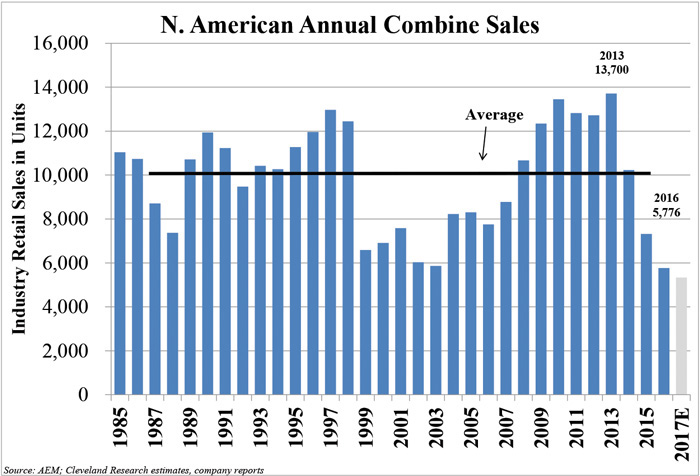
I am going to take a "wait and see" attitude. Why? It's all centred on if/when:
A recent series of articles would suggest that this is the case in the short term.
In order to "take the pulse" of the equipment sector, I consult several trade publications on a regular basis - among them:
Farm Equipment
The Progressive Farmer
Agrinews
Farm Journal
Capital Press
Regional newspapers are also a useful source. For the "long view" I turn to state and national governments, especially when investigating themes for potential investments. Some universities with major agricultural programs yield precious insights as well.
Combined, these source provide a variety of insights:
- a sense of the prevailing mindsets of the agricultural community
- "hard" information on topics such as yields, sales
- developing trends
- leads on innovative products/services (Clean Seed Capital come on down)
You hardly ever get this comprehensive perspective in reports issued by investment analysts: they simply do not have the time. When I look back at the history of my most successful investments in agriculture, virtually all of them originated on the basis of leads generated by extensive reading of the above-noted sources. Not one of the leads was generated by reading the financial press or reports by financial analysts. (They are generally quite boring - same old same old metrics and approach and lacking the freshness and enthusiasm of the best of the movers within the agricultural community.)
I have been interested in sales of agricultural equipment, the result of deciding to focus on equipment manufacturers and dealers a few years ago. There is a central theme which dominates thinking in the sector; namely, annual sales. It can be reduced to the graph which appears below which is presented in:
The Hits Keep on Coming
There are several possible interpretations of the graph:
- We may be in a multi-year period of relatively low sales if one thinks that there will be a repeat of the years 1999 - 2006. If one considers that farm input costs are still rising and that commodity prices are likely to remain low, the outlook for future sales may not be all that attractive. In this environment, farmers seek to minimize operational costs. They are keeping old equipment longer and not buying new equipment as much. (Parts/service receipts from dealers would suggest that this is the case.) Also, used equipment prices would appear to be attractive as dealers seek to clear their inventories of used equipment.
- It would appear that sales of new equipment are near an all-time low, at least relative to 1985. On this basis alone, some may contend that things cannot stay at this level forever. Others may opine that the "replacement cycle" for equipment may cut in at some point, especially on the part of larger operators where there is an imperative for reliability.
I am going to take a "wait and see" attitude. Why? It's all centred on if/when:
- There yet remains a strong potential for a significant correction in the stock market. If/when this occurs, the exchange listed stocks of equipment manufacturers and dealers will inevitably fall in the general downdraft. If/when this happens, investors will be presented with an excellent buying opportunity.
- Commodity prices are likely to increase at some point due to a variety of factors such as differences in yearly yields in major producing countries/regions. If/when this occurs, farmers will have funds for new purchases. This said, there are headwinds for North American farmers: the uncertainty of NAFTA, the new normal of major climate/weather events, increased competition from producers/marketers in South America, etc.
- At some point, the equipment replacement cycle will turn. It will simply be uneconomic to repair old equipment and retain an acceptable level of reliability. This is not a question of if but when.
On balance:
- I think that the replacement cycle is starting to kick in. But alone, it will not propel significant sales. There are still sufficient stocks of low hour equipment to dampen sales in the short term, especially given that farmers appear to be quite conservative in their outlook (this on the experience of being over-extended a decade ago). For this reason, I will defer on investing for the time being.
- My trigger point for buying will be a downturn in the general market. Farm equipment manufactures and dealers know how to manage their way through lean times, and the best of them will position themselves for an eventual recovery. A market downturn may represent an excellent entry point and an opportunity to profit in the inevitable recovery in the sector.
I have only one position in the agricultural sector: Clean Seed Capital.
Why?
- It has great bones. See previous posts.
- It meets a real need in a way that confers real benefits for its customers.
- It's characteristics are such that it can survive the low point in the agricultural cycle.
- Most important: it has the potential (in my view) to profit mightily once the agricultural equipment cycle turns. This could take place in a variety of scenarios: increased revenue from sales, a take-over by one of the major equipment manufacturers. (See the recent additions to the Board of Directors as the company may be covering its bets on this possibility. http://cleanseedcapital.com/gary-anderson-joins-board-directors-acquires-5-interest-clean-seed-capital-group-ltd-tsx-v-csx/
- I am prepared for the inevitable gyration in the price of CSX, recognizing that it is a nascent enterprise. As such, I am not prepared to attempt "to time the market" this time.
Monday, 6 November 2017
The Financial Log Book - Performance of Investments - November 2017
Mindful of the potential for a decline in the market (see previous posts) I have decided to trim my holdings:
* Prices are quoted in the currency of the exchanges where equities are listed. As a result the gain/loss is not an accurate measure of the performance of the portfolio as the $US has risen significantly against the $=Cdn since many US positions were established.
** Gain/Loss exclusive of dividends
10.58 sale price for offloaded crew members
Relative weightings of holdings in the portfolio when the position was first established:
H = >9%
M = 5-9%
L = <5%
Commentary on Selected Holdings
Agriculture
Farm incomes are suffering throughout North America for two main reasons:

- to release some members of the crew whose prospects were judged not to be all that rosy in the short to intermediate term e.g. agricultural companies
- to take profits and add to my stash of cash
- Cash is often "king" in tough times.
- If the market declines, valuations may become more attractive and offer the potential for greater gains than presently.
- I will not get poor by taking profits.
- I've organized my financial affairs such that I can bide my time until valuations are more attractive.
- I have reconciled the conflict of trying to time the market with the desire to protect my portfolio. On balance, I believe that markets are due for a major correction.
This said, I have not stopped my investing activity. If anything, I am working harder than in previous months:
- I am searching for companies with the potential to outperform their peers during a recovery period aka "rebound kings".
- I have intensified my research in a few strategic areas which I feel will offer the potential for profitable investments.
- I increased holdings in some positions e.g. Fairfax India
| Entity |
Wt
| Initial Price/ Purchase * Date | Price * Nov 6/17 | Gain/Loss since Jan 1/17 % | Gain/Loss** Since Purchase % |
|---|---|---|---|---|---|
Wheaton Precious Metals (WPM) (formerly Silver Wheaton)
|
H
|
12.37
2007-09-04
|
26.71
|
4.2
|
213.2
|
| Polaris Materials Corporation (PLS) SOLD |
L
|
10.70
2007-06-01
|
SOLD
ouch |
2017-08-01
|
- 92
|
| Cenovus (CVE) SOLD |
M
|
32.39
2010-07-27
|
SOLD
|
2017-08-24
|
9.26
|
| North West Company (NWF) SOLD |
H
|
16.23
2009-05-07
|
SOLD
|
2017-08-11
|
30.37
|
| Deere & Company (DE) SOLD |
H
|
88.07
2013-01-03
|
SOLD
|
2017-08-01
|
128.04
|
| Rocky Mountain Dealerships (RME) SOLD |
H
|
11.89
2013-01-03
|
SOLD
|
2017-08-22
|
11.12
|
| Oaktree Capital Group (OAK) |
M
|
56.45
2013-10-28
|
43.75
|
24.5
|
-22.50
|
| Fairfax Financial Holdings (FFH) SOLD |
H
|
477.98
2014-3-25
|
SOLD
| 2017-03-08 |
624.10
|
| Clean Seed Capital (CSX) |
M
|
.51
2015-01-07
|
0.47
|
30.7
|
-7.84
|
| Abitibi Royalties (RZZ) |
M
|
2.57
2015-11-20
|
8.05
|
-0.70
|
212.2
|
| Input Capital (INP) |
L
|
1.86
2015-11-20
|
1.64
|
-14.9
|
-11.83
|
| Fairfax India Holdings Corp (FIH.U) |
H
|
10.42
2015-12-16
|
15.57
|
34.8
|
49.42
|
| CRH Medical Corp (CRH) SOLD |
M
|
4.43
2105-12-29
|
SOLD
| 2017-03-21 |
10.58
|
** Gain/Loss exclusive of dividends
10.58 sale price for offloaded crew members
Relative weightings of holdings in the portfolio when the position was first established:
H = >9%
M = 5-9%
L = <5%
Commentary on Selected Holdings
Agriculture
Farm incomes are suffering throughout North America for two main reasons:
- low commodity prices
- increased costs
As a result, farmers are economizing: reducing inputs of fertilizers, delaying purchases of new equipment, sourcing cheaper seeds etc.
Many companies such as Rocky Mountain Equipment and Deere have adapted to the cyclical nature of the farming industry; however, I am concerned that share prices will be taken down unduly when/if a major correction takes place in the markets. In this scenario, valuations could become more attractive.
I have retained my position with Clean Seed Capital. It is a nascent company with "good bones": able management, supportive and understanding investors who know the farming business, a product with the distinct potential to provide a substantial benefit to farmers and which positioned to meet the needs associated with the trend to larger scale farming operations (farm consolidation is still taking place).
I realize that this is not consistent with actions regarding my former holdings in agriculture. I have a professional history of working with new enterprises. As a result, I have a "soft spot" for supporting innovation and a tolerance for the volatility that characterizes that space. Investing is a messy business!
I realize that this is not consistent with actions regarding my former holdings in agriculture. I have a professional history of working with new enterprises. As a result, I have a "soft spot" for supporting innovation and a tolerance for the volatility that characterizes that space. Investing is a messy business!
Ditto for Input Capital. I am interested to see how the company will do in the depths of the agricultural cycle and how it will perform if commodity prices become more volatile. Having skin in the game makes this more than a passive exercise. Further, I consider that the lessons learned can be applied elsewhere.
Resilient Companies
With some misgiving, I have jettisoned a few crew members.
The North West Company is well positioned to survive during tough times. In a sense, NWF has a captive market. It is more able than its competitors in a significant part of its market area. In retrospect, I should not have sold it but who says that investing is a rational process.
Fairfax Financial Holdings has the challenge of adjusting to the "new normal" of climate change: more frequent and severe climatic events such as hurricanes. I admire the management of Fairfax greatly and decided to shift my money to another of its operations; namely, Fairfax India Holdings in the belief that it presents a better investment opportunity. So far, this thinking has been rewarded.
Fossil Fuels
I have decided to sell off my positions in this facet of the energy field with the thought that there are better investment opportunities elsewhere.
This said, I have a substantial position in an enterprise which is not noted in the Financial Log Book.
Questor Technology Inc. is, in my opinion, a fabulous company. It has great management which is well attuned to the oil patch, good financial bones etc. Moreover, it has demonstrated its agility to adapt to a changing market (rental versus purchase of its incinerators). It is actively exploiting the potential of its technology for applications beyond the oil patch. Check out its recent corporate presentations:
While researching the company, I discovered Investorfile, a site maintained by Gerry Wimmer. It focuses on small cap listings. I subscribe to his blog via e-mail. He has an excellent write-up for Questor Technologies - so no need to elaborate further on my part.
I had the good fortune to have taken profits near the peak of its market price and the luck to have gotten in again after the stock sagged. In recent months, investors have been rewarded richly.
I had the good fortune to have taken profits near the peak of its market price and the luck to have gotten in again after the stock sagged. In recent months, investors have been rewarded richly.
https://finance.google.com/finance?q=CVE:QST
Precious Metals
I purchased Silver Wheaton when its business model was novel and when it pretty well had the market to itself. It was my first ten bagger.
Things have changed. It has more competitors. I reduced my position in the intervening years and took some profits. My reason for retaining a position is my belief in the safe haven value of gold and silver during tough times. Besides, it is a favourite pet, an old and faithful companion that has served me well.
A far more interesting company is Abitibi Royalties. In brief, it is a play on the potential for increased gold prices and the possibility that some properties in its portfolio will be developed as working mines. If this occurs, Abitibi will profit mightily. See earlier posts for a discussion of the company.
The share price increased significantly during the company's early years as a result of investor interest in its business model. Since then, the "action" has settled down. In recent months, there appears to be some encouraging exploration activity in a few properties in Abitibi's portfolio. If mine development takes place and if metals prices increase, Abitibi's investors could be rewarded nicely. This is the essence of my thesis for investing in the company ... coupled with its other laudable attributes: sage management, a great balance sheet, strong connections with key actors in the gold mining community, a business model which is somewhat novel and which addresses a specific niche without too much competition.
Subscribe to:
Posts (Atom)